
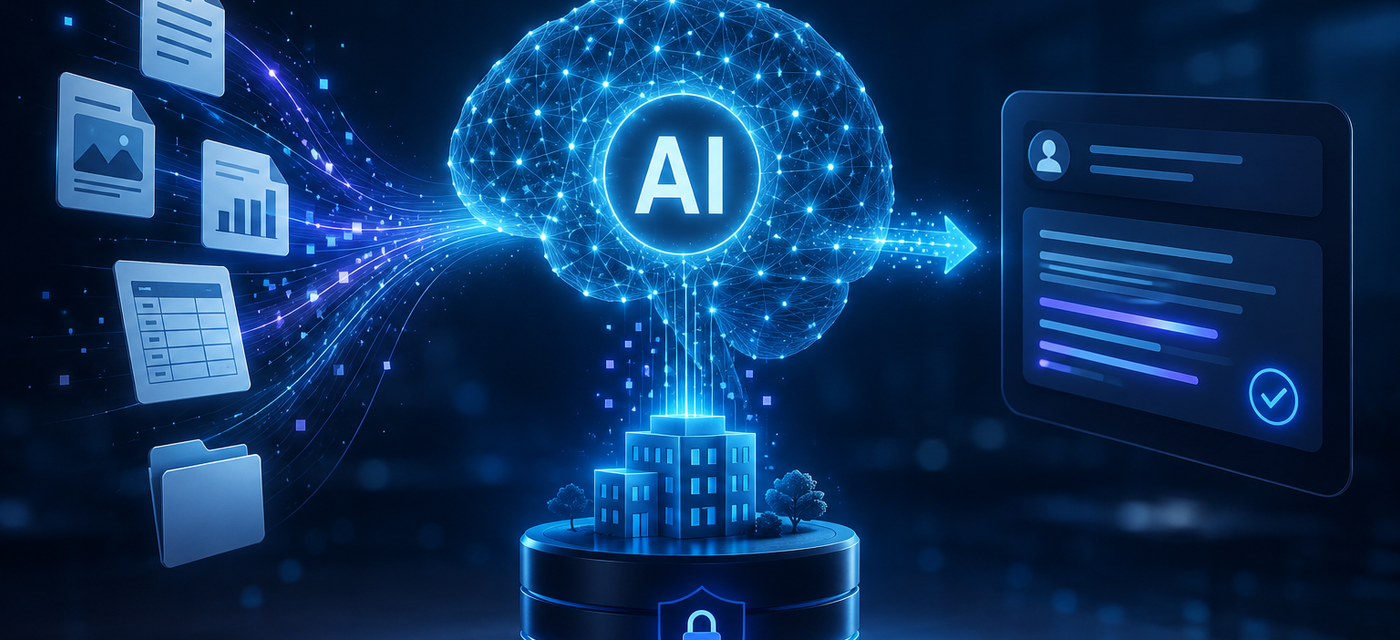
Large language models know an impressive amount about the world — and nothing about what happens inside your company. They have never seen your contracts, your price lists, your internal policies or last week's project decisions. RAG (Retrieval-Augmented Generation) bridges exactly this gap: before answering, the AI retrieves the relevant knowledge from your own documents.
What is RAG?
RAG — retrieval-augmented generation — is an architecture in which the language model doesn't answer "from memory" but works from source material. Before the answer is produced, a retrieval layer finds the passages in the company knowledge base that best match the question, and the model receives them together with the question. It is like a good expert who opens the case file before answering — relying on the documents in front of them, not on recollection.
Why isn't the model enough on its own?
- Its knowledge has a boundary: the model only "sees" up to the end of its training — it cannot know about yesterday's price change or the new policy.
- Your internal data is not public: the model has never seen your contracts, proposals or processes — so it cannot answer from them.
- Hallucination: without sources, the model confidently fills in the gaps. In a business context, a convincing-sounding but wrong answer costs more than an "I don't know".
A common misconception is that fine-tuning solves this. Fine-tuning shapes the model's style and behaviour, but it is expensive and unwieldy for handling fresh, changing factual material: every update would require retraining, and it cannot point to sources for its answers. RAG, by contrast, always works from the current documents.
How does it work, step by step?
1. Processing: the system ingests the documents (PDFs, wiki pages, meeting notes, emails) and splits them into smaller, self-contained chunks.
2. Embedding: each chunk is turned into a numeric vector that captures the meaning of the text. Two passages with similar content end up with vectors close to each other — even if they are phrased completely differently.
3. Vector database: the vectors go into a purpose-built database that can be searched by meaning. This is the system's long-term memory.
4. Retrieval: when a question arrives, it is converted into a vector too, and the database instantly finds the passages closest to it in meaning.
5. Generation: the model receives the question together with the retrieved passages, and shapes them into a precise answer that can be traced back to its sources.
What is it good for in practice?
- Internal knowledge assistant: "What is the annual-leave process?" — the answer comes from your own policy, not from a generic guess.
- Customer support: the bot answers from the real product documentation and past tickets, so it can afford to be specific.
- Contracts and proposals: "Which of our clients has payment terms longer than 30 days?" — seconds instead of minutes.
- Onboarding: the new colleague asks the knowledge base the thousandth question instead of their teammates — and the knowledge base never gets tired.
The pitfalls where most projects slip
- Bad chunking: if the text breaks at meaningless points, retrieval finds half-sentences — answer quality is decided where the documents are processed.
- Stale content: RAG is exactly as good as the knowledge base behind it. Without an update process, the system will confidently quote last year's price list.
- Missing access control: if everyone can query everything, the salary spreadsheet is one well-aimed question away. Retrieval must respect access levels.
- Blind trust: without source attribution and regular evaluation, you never learn when the system answers from its "imagination" instead of the documents.
How should you get started?
Don't start with the vision of an "all-knowing company brain" — start with a small, measurable pilot: one document type, one team, one well-defined set of questions. Measure what percentage of answers are accurate and how much time the team saves — and if the numbers are good, expand from there with confidence. In our experience, a working pilot is also the best argument inside the organisation.
Summary
With RAG, artificial intelligence finally works from your data: up to date, with sources, verifiably. It is not magic but a carefully designed data flow — and its quality depends on the details: chunking, retrieval accuracy, freshness and permissions. Get those right, and AI stops being a flashy toy and becomes a colleague you use every day.